All content on this site is intended for healthcare professionals only. By acknowledging this message and accessing the information on this website you are confirming that you are a healthcare professional. If you are a patient or carer, please visit the MPN Advocates Network.
The MPN Hub website uses a third-party service provided by Google that dynamically translates web content. Translations are machine generated, so may not be an exact or complete translation, and the MPN Hub cannot guarantee the accuracy of translated content. The MPN Hub and its employees will not be liable for any direct, indirect, or consequential damages (even if foreseeable) resulting from use of the Google Translate feature. For further support with Google Translate, visit Google Translate Help.


The MPN Hub is an independent medical education platform, sponsored by GSK, Novartis, Sobi and Takeda and supported through independent educational grants from Bristol Myers Squibb, Blueprint Medicines, Incyte and Merck Sharp & Dohme LLC, Rahway, NJ, USA. Funders are allowed no direct influence on our content. The levels of sponsorship listed are reflective of the amount of funding given. View funders.
Now you can support HCPs in making informed decisions for their patients
Your contribution helps us continuously deliver expertly curated content to HCPs worldwide. You will also have the opportunity to make a content suggestion for consideration and receive updates on the impact contributions are making to our content.
Find out more
Create an account to access:
Bookmark & personalize site content
Receive alerts for new content in your areas of interest
View MPN content recommended for you
 Andreas Reiter
Do you know... Approximately what proportion of patients with advanced systemic mastocytosis harbor the KIT D816V mutation?
During the MPN Hub Steering Committee Meeting on May 26, 2026, key opinion leaders met to discuss targeting KIT in advanced systemic mastocytosis (AdvSM). The session opened with a presentation by Andreas Reiter, University Hospital Mannheim, Mannheim, DE, and was followed by a discussion with MPN Hub Steering Committee Chair Jean-Jacques Kiladjian and Steering Committee member Steffen Koschmieder.
Targeting KIT in advanced systemic mastocytosis
Targeting KIT in advanced systemic mastocytosis
In this presentation, Reiter discusses the rationale for KIT inhibition, and key efficacy and safety data for KIT-targeting therapies in AdvSM. The presentation highlights data from key trials, including the depth of molecular response with KIT-targeting therapies and its correlation with clinical benefit, and concludes with an overview of future directions in KIT inhibition for patients with AdvSM. The presentation was followed by a discussion in which the Steering Committee explored the clonal evolution of AdvSM, its implications for treatment, molecular indicators of response, and practical approaches to adverse event management.
Key points
- AdvSM is a hematologic neoplasm characterized by excessive proliferation and accumulation of mast cells, resulting in organ damage.1
- KIT D816V is a central disease driver, present in ~95% of patients with AdvSM.2
- Midostaurin is a first-generation KIT-targeting therapy that established the benchmark for the treatment of patients with AdvSM, although its efficacy is limited and treatment may be complicated by adverse events.3
- Avapritinib is a next-generation KIT inhibitor that is highly selective for KIT D816V. Other selective KIT D816V inhibitors in development include bezuclastinib and elenestinib.2,4
- Evidence supporting avapritinib in AdvSM comes from a clinical development program spanning early‑phase, registrational, pooled, and long‑term follow‑up studies, including the phase I EXPLORER trial (NCT02561988) and the phase II PATHFINDER trial (NCT03580655) (Figure 1).1-3,5
- In the PATHFINDER trial, 60% of patients receiving avapritinib achieved ≥50% reduction in KIT D816V VAF; greater reductions in KIT D816V VAF were associated with deeper clinical responses.1,3
- The 4-year follow-up of the PATHFINDER trial confirmed that these deep molecular responses translated into durable clinical benefit, with sustained responses and prolonged survival in patients with AdvSM.6
- Long-term follow-up demonstrated a manageable safety profile, with dose optimization improving treatment tolerability while maintaining durable clinical responses.6
- Protocol amendments, including withholding treatment in patients with platelet counts ≤50 × 10⁹/L and optimized management of thrombocytopenia, substantially reduced intracranial bleeding events compared with earlier avapritinib studies.6
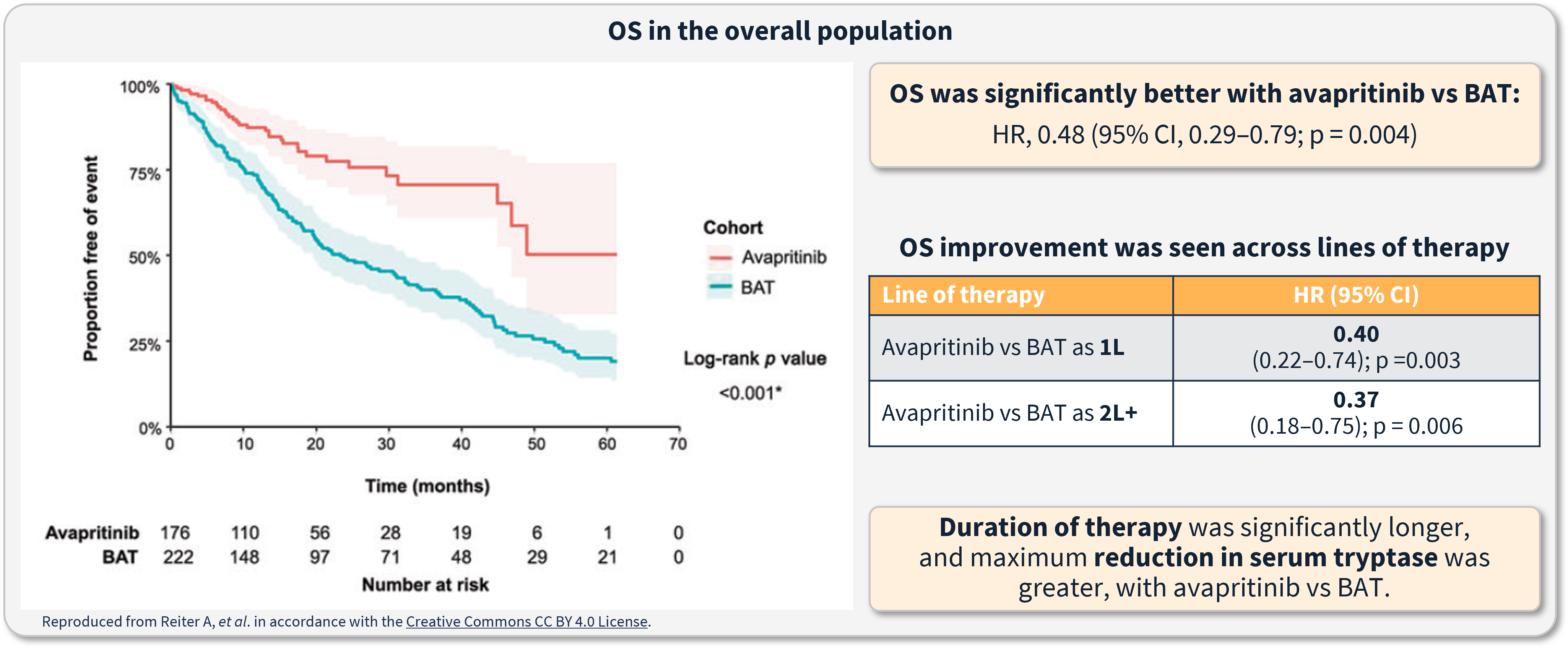
- In an adjusted comparative analysis, avapritinib was associated with significantly improved overall survival vs best available therapy (HR, 0.48; 95% CI, 0.29–0.79; p = 0.004) (Figure 2).7
- Next-generation KIT inhibitors aim to expand treatment options for patients with AdvSM while optimizing efficacy and tolerability.4
- Overall, the panel emphasized the importance of understanding clonal evolution, integrating molecular monitoring into clinical practice, and proactively managing adverse events to optimize long-term outcomes for patients with AdvSM.
Figure 1. Pooled analysis of the EXPLORER and PATHFINDER trials of avapritinib in advanced systemic mastocytosis*
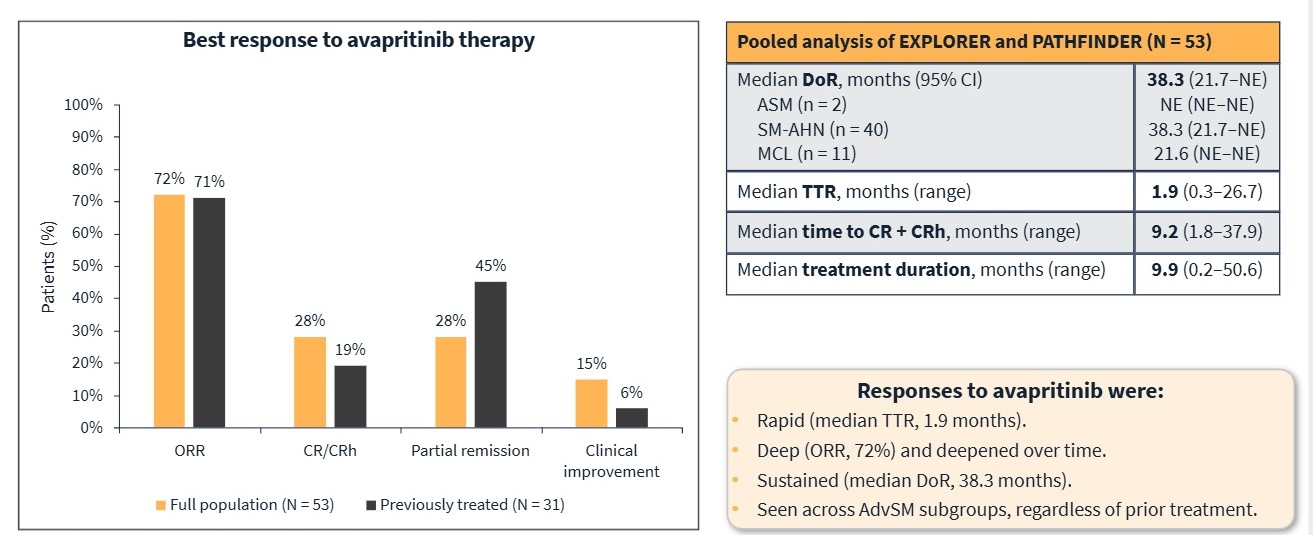
Figure 2. Multicenter, retrospective chart review study comparing real-world BAT with avapritinib in the EXPLORER and PATHFINDER studies*
This educational resource is independently supported by Blueprint Medicines. All content is developed by SES in collaboration with an expert steering committee. Funders are allowed no influence.
References
Please indicate your level of agreement with the following statements:
The content was clear and easy to understand
The content addressed the learning objectives
The content was relevant to my practice
I will change my clinical practice as a result of this content
This content is accurate as of the date of publication and is not updated retrospectively. Please refer to the latest available evidence, guidelines, and relevant regulatory information when making clinical decisions.
Your opinion matters
Among patients with myelofibrosis and isolated anemia at presentation, with no indication for treatment with a JAK inhibitor, how often do you use anemia-directed treatments (EMAs, ESAs, danazol, etc.) as monotherapy?