All content on this site is intended for healthcare professionals only. By acknowledging this message and accessing the information on this website you are confirming that you are a healthcare professional. If you are a patient or carer, please visit the MPN Advocates Network.
The MPN Hub website uses a third-party service provided by Google that dynamically translates web content. Translations are machine generated, so may not be an exact or complete translation, and the MPN Hub cannot guarantee the accuracy of translated content. The MPN Hub and its employees will not be liable for any direct, indirect, or consequential damages (even if foreseeable) resulting from use of the Google Translate feature. For further support with Google Translate, visit Google Translate Help.


The MPN Hub is an independent medical education platform, sponsored by GSK, Novartis, Sobi and Takeda and supported through independent educational grants from Bristol Myers Squibb, Blueprint Medicines, Incyte and Merck Sharp & Dohme LLC, Rahway, NJ, USA. Funders are allowed no direct influence on our content. The levels of sponsorship listed are reflective of the amount of funding given. View funders.
Now you can support HCPs in making informed decisions for their patients
Your contribution helps us continuously deliver expertly curated content to HCPs worldwide. You will also have the opportunity to make a content suggestion for consideration and receive updates on the impact contributions are making to our content.
Find out more
Create an account to access:
Bookmark & personalize site content
Receive alerts for new content in your areas of interest
View MPN content recommended for you
Symposium | Advanced systemic mastocytosis: Diagnosis, risk stratification, and response assessment in 2026
Featured:
 Johannes Lübke
Do you know... Which of the following best characterizes the emerging role of peripheral blood KIT D816V testing in advanced systemic mastocytosis?
At the European Hematology Association (EHA) 2026 Congress, June 11–14, 2026, Stockholm, SE, the MPN Hub held a symposium, titled Advanced systemic mastocytosis: Redefining the disease, rethinking patient outcomes. During the symposium, Johannes Lübke, University Hospital Mannheim, Mannheim, DE, delivered a presentation on diagnosis, risk stratification, and response assessment in advanced systemic mastocytosis (AdvSM).
Symposium | Advanced systemic mastocytosis: Diagnosis, risk stratification, and response assessment in 2026
Symposium | Advanced systemic mastocytosis: Diagnosis, risk stratification, and response assessment in 2026
Lübke discusses the current diagnostic framework for systemic mastocytosis, emphasizing the need for integrated disease assessment beyond established diagnostic criteria. Lübke explores the role of molecular profiling in prognostic risk stratification, evolving prognostic models in the era of KIT-targeted therapy, current and emerging approaches to response assessment, and the complementary role of patient-reported outcomes in evaluating disease burden and treatment benefit.
Key points
- Diagnosis of systemic mastocytosis is based on established World Health Organization (WHO) and International Consensus Classification (ICC) major and minor criteria incorporating morphologic, immunophenotypic, molecular, and biochemical findings.1
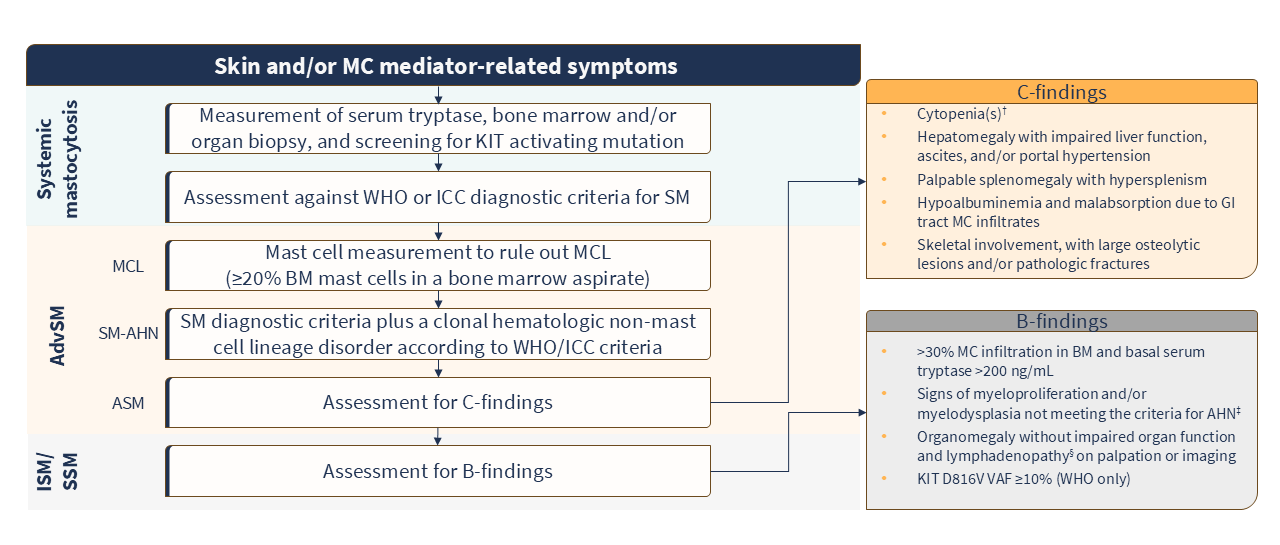
- Following diagnosis, disease subtyping distinguishes indolent from AdvSM based on mast cell burden, associated hematologic neoplasms, and the presence of B- and C-findings (Figure 1).1
Figure 1. Framework for diagnosing and subtyping systemic mastocytosis*
- Established diagnostic criteria provide the framework for diagnosis; however, serum tryptase, KIT D816V allele burden, mast cell infiltration, organ involvement, and symptom burden do not always correlate with each other or specific subtypes.1
- Integrated clinical, pathological, and molecular assessment is therefore required to accurately characterize disease burden and inform management strategies.
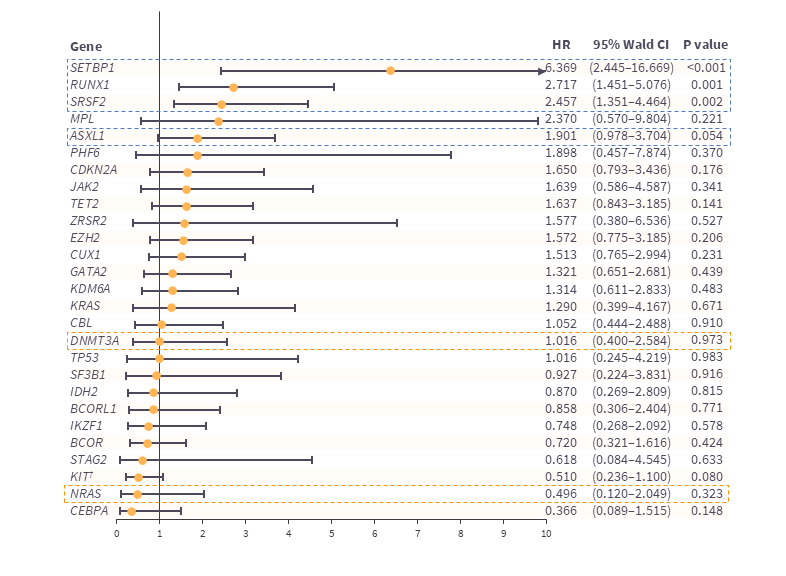
- Baseline molecular profiling demonstrated that >90% of patients with AdvSM treated with avapritinib harbored at least one additional somatic mutation beyond KIT D816V.2
- Mutations in SETBP1, RUNX1, and SRSF2 were associated with inferior overall survival, supporting incorporation of molecular profiling into prognostic assessment (Figure 2).2
Figure 2. Genomic correlates of overall survival in advanced systemic mastocytosis*
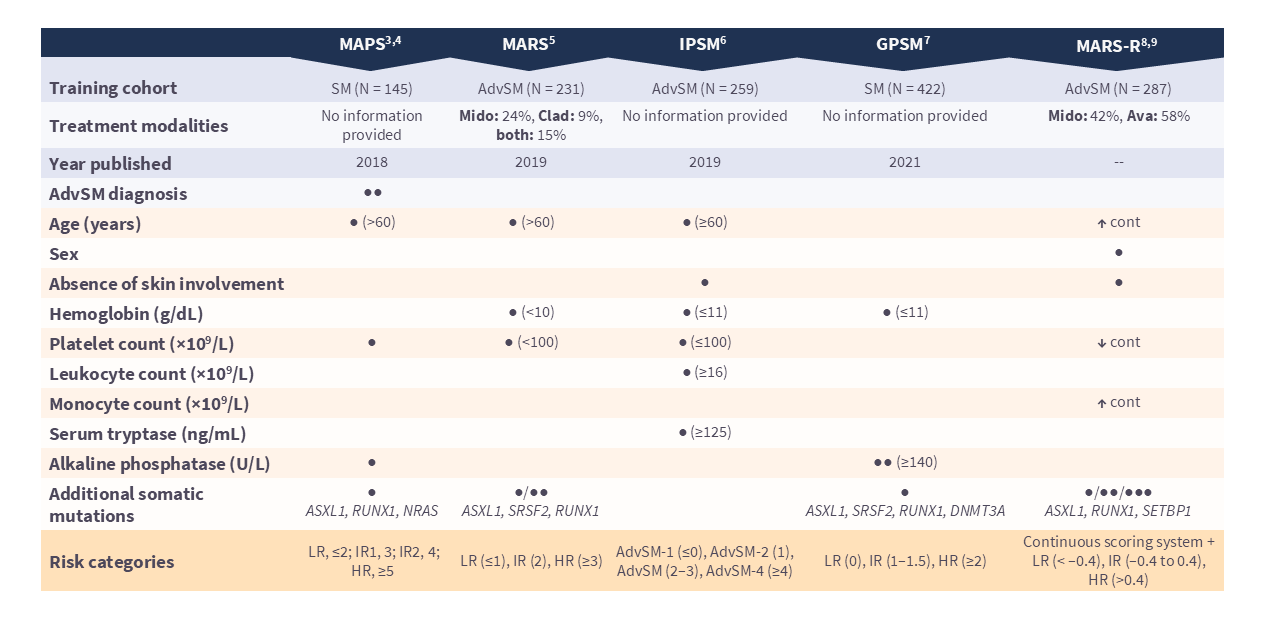
- Contemporary prognostic models are evolving beyond categorical clinical variables to better reflect the molecular complexity of AdvSM, with the emerging revised Mutation-Adjusted Risk Score (MARS-R) incorporating continuous clinical and molecular parameters to support individualized risk stratification. (Figure 3).3–9
Figure 3. Evolution of prognostic risk stratification in advanced systemic mastocytosis*
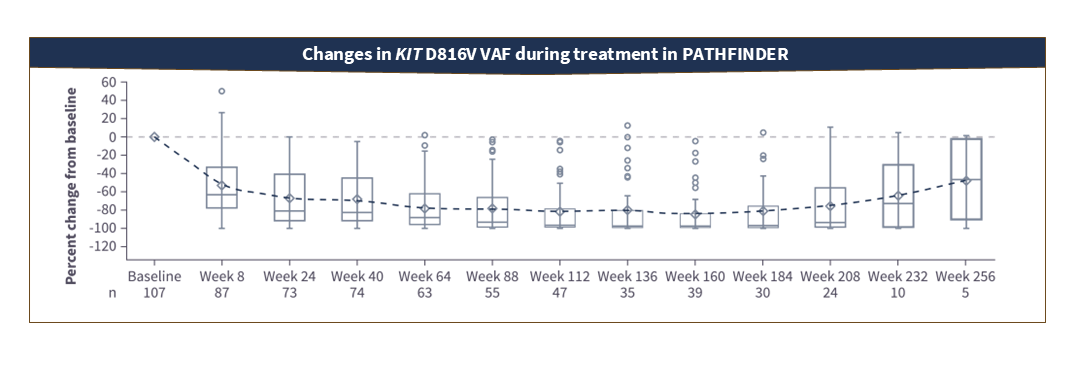
- High-sensitivity peripheral blood and bone marrow KIT D816V testing enables quantification of disease burden and complements response assessment by monitoring molecular response and residual disease during therapy (Figure 4).10–13
Figure 4. KIT D816V variant allele frequency as a biomarker of residual disease in advanced systemic mastocytosis*
- Although mIWG-MRT-ECNM criteria standardize response assessment in clinical trials, complementary molecular biomarkers may provide a more practical approach to monitoring treatment response in routine clinical practice.11,12
- Patient-reported outcomes complement laboratory and organ-based assessments by capturing symptom burden, quality of life, functional impairment, and treatment benefit.13
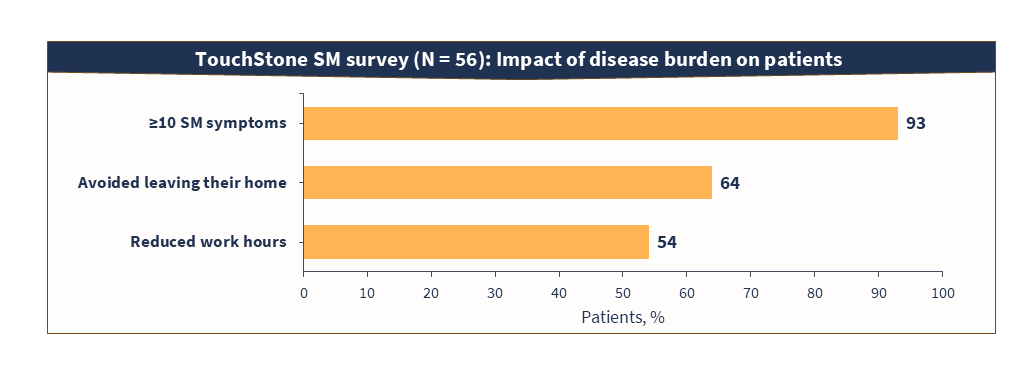
- In the TouchStone survey, 93% of patients reported ≥10 symptoms, 64% avoided leaving home, and 54% reduced working hours because of disease burden (Figure 5).13
Figure 5. Patient-reported outcomes as part of response assessment in SM*
- Diagnosis, prognostic assessment, and response evaluation in AdvSM require integration of clinical, molecular, pathological, and patient-reported measures to support individualized patient management.
This educational resource is independently supported by Blueprint medicines. All content is developed by the faculty in collaboration with SES. Funders are allowed no influence.
References
Please indicate your level of agreement with the following statements:
The content was clear and easy to understand
The content addressed the learning objectives
The content was relevant to my practice
I will change my clinical practice as a result of this content
More from this series: