All content on this site is intended for healthcare professionals only. By acknowledging this message and accessing the information on this website you are confirming that you are a healthcare professional. If you are a patient or carer, please visit the MPN Advocates Network.
The MPN Hub website uses a third-party service provided by Google that dynamically translates web content. Translations are machine generated, so may not be an exact or complete translation, and the MPN Hub cannot guarantee the accuracy of translated content. The MPN Hub and its employees will not be liable for any direct, indirect, or consequential damages (even if foreseeable) resulting from use of the Google Translate feature. For further support with Google Translate, visit Google Translate Help.


The MPN Hub is an independent medical education platform, sponsored by GSK, Novartis, Sobi and Takeda and supported through independent educational grants from Bristol Myers Squibb, Blueprint Medicines, Incyte and Merck Sharp & Dohme LLC, Rahway, NJ, USA. Funders are allowed no direct influence on our content. The levels of sponsorship listed are reflective of the amount of funding given. View funders.
Now you can support HCPs in making informed decisions for their patients
Your contribution helps us continuously deliver expertly curated content to HCPs worldwide. You will also have the opportunity to make a content suggestion for consideration and receive updates on the impact contributions are making to our content.
Find out more
Create an account to access:
Bookmark & personalize site content
Receive alerts for new content in your areas of interest
View MPN content recommended for you
Symposium | Looking ahead: Future directions and unanswered questions in advanced systemic mastocytosis (panel discussion and Q&A)
 Alessandro M. Vannucchi
 Andreas Reiter
 Deepti H Radia
 Johannes Lübke
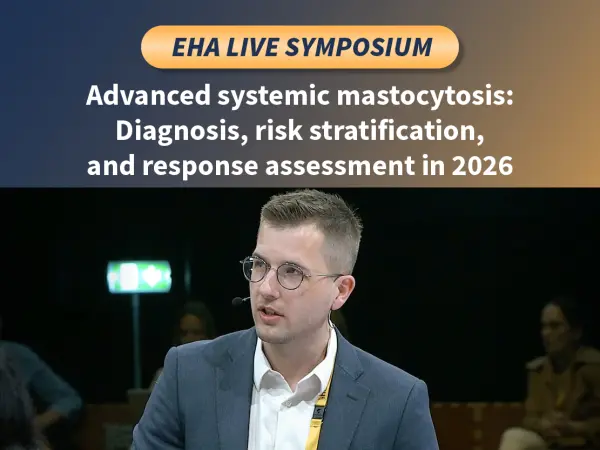
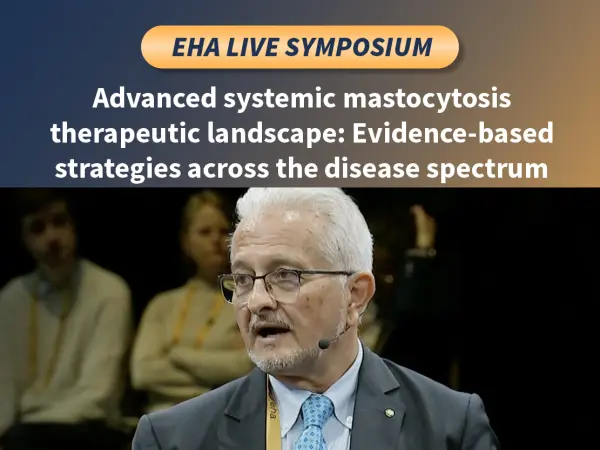
At the European Hematology Association (EHA) 2026 Congress, June 11–14, 2026, Stockholm, SE, the MPN Hub held a symposium, titled Advanced systemic mastocytosis: Redefining the disease, rethinking patient outcomes. The symposium closed with a panel Q&A session, chaired by Deepti H Radia, alongside faculty members Andreas Reiter, Johannes Lübke, and Alessandro Vannucchi.
Symposium | Looking ahead: Future directions and unanswered questions in advanced systemic mastocytosis (panel discussion and Q&A)
Symposium | Looking ahead: Future directions and unanswered questions in AdvSM
The panel explored key challenges in advanced systemic mastocytosis (AdvSM), including underdiagnosis and complexities in the management of SM with an associated hematologic neoplasm (AHN), and mast cell leukemia (MCL). They also discussed emerging combination therapies and highlighted allogeneic hematopoietic stem cell transplantation (allo-HSCT) as the only potentially curative option in AdvSM, emphasizing the importance of optimal disease control prior to transplantation.
Key points
- Reported prevalence figures for AdvSM are likely an underestimate of the true disease burden owing to underdiagnosis.1
- Bone marrow evaluation remains a key component of the diagnostic workup for AdvSM.2,3
- KIT D816V mutation testing should be performed in both peripheral blood and bone marrow using highly sensitive assays (e.g. digital droplet polymerase chain reaction [PCR] or quantitative PCR), as a negative peripheral blood result does not exclude SM.3,4
- Treatment decisions for SM-AHN should be individualized based on several factors, including the AHN subtype and KIT D816V allele burden.3,5
- SM associated with a JAK2-positive myeloproliferative neoplasm (MPN) may, in some cases, represent a more indolent disease phenotype. Where treatment is required, the AHN component may warrant greater therapeutic attention than the SM.6
- Reassessment of both the SM and AHN components throughout treatment is important.5
- Combining KIT inhibitors with hypomethylating agents is a rational strategy for patients with SM and acute myeloid leukemia (AML); however, it remains investigational, with safety concerns including treatment-related cytopenias.5
- Specific treatment options for MCL remain limited, and therapies used for both SM and AML have been applied with variable success.7
- Targeted therapies, such as tyrosine kinase inhibitors aimed at KIT mutations, have shown promising results in some types of MCL, with chemotherapy reserved for MCL with aggressive AHN.7
- Allo-HSCT is the only known potentially curative treatment option for AdvSM.2
- While targeted therapies can facilitate improved pre-transplant disease control, treatment and transplantation decisions remain highly individualized, particularly with respect to patient factors such as age and fitness.2,3,8
This educational resource is independently supported by Blueprint medicines. All content is developed by the faculty in collaboration with SES. Funders are allowed no influence.
References
Please indicate your level of agreement with the following statements:
The content was clear and easy to understand
The content addressed the learning objectives
The content was relevant to my practice
I will change my clinical practice as a result of this content
This content is accurate as of the date of publication and is not updated retrospectively. Please refer to the latest available evidence, guidelines, and relevant regulatory information when making clinical decisions.
More from this series:
Symposium series | Advanced systemic mastocytosis: Redefining the disease, rethinking patient outcomes



Your opinion matters
Among patients with myelofibrosis and isolated anemia at presentation, with no indication for treatment with a JAK inhibitor, how often do you use anemia-directed treatments (EMAs, ESAs, danazol, etc.) as monotherapy?