All content on this site is intended for healthcare professionals only. By acknowledging this message and accessing the information on this website you are confirming that you are a healthcare professional. If you are a patient or carer, please visit the MPN Advocates Network.
The MPN Hub website uses a third-party service provided by Google that dynamically translates web content. Translations are machine generated, so may not be an exact or complete translation, and the MPN Hub cannot guarantee the accuracy of translated content. The MPN Hub and its employees will not be liable for any direct, indirect, or consequential damages (even if foreseeable) resulting from use of the Google Translate feature. For further support with Google Translate, visit Google Translate Help.


The MPN Hub is an independent medical education platform, sponsored by GSK, Novartis, Sobi and Takeda and supported through independent educational grants from Bristol Myers Squibb, Blueprint Medicines, Incyte and Merck Sharp & Dohme LLC, Rahway, NJ, USA. Funders are allowed no direct influence on our content. The levels of sponsorship listed are reflective of the amount of funding given. View funders.
Now you can support HCPs in making informed decisions for their patients
Your contribution helps us continuously deliver expertly curated content to HCPs worldwide. You will also have the opportunity to make a content suggestion for consideration and receive updates on the impact contributions are making to our content.
Find out more
Create an account to access:
Bookmark & personalize site content
Receive alerts for new content in your areas of interest
View MPN content recommended for you
Visual abstract | Phase III INDEPENDENCE trial: Luspatercept for MF-associated anemia
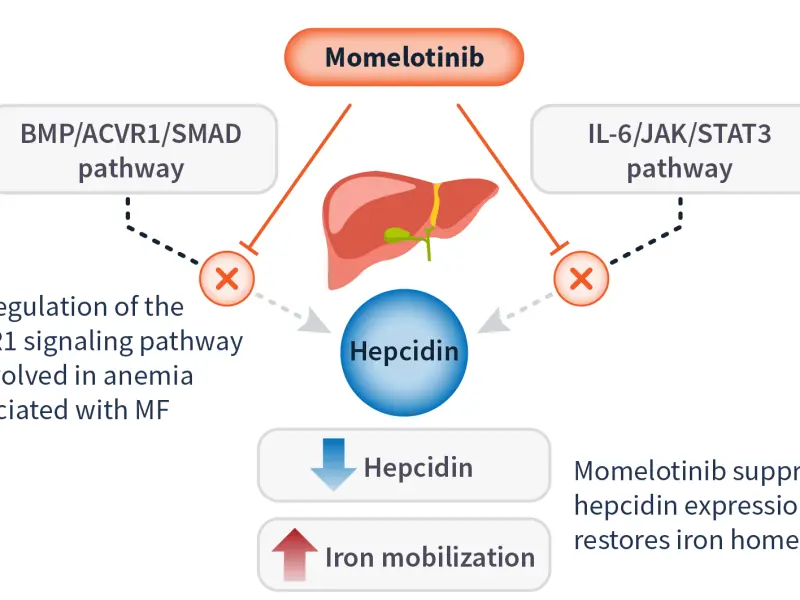
Do you know... Luspatercept is being assessed in the phase III INDEPENDENCE trial for the treatment of MF-associated anemia. What is its mechanism of action?
Anemia is a common manifestation of myelofibrosis (MF) that worsens with disease progression, with most patients eventually becoming dependent on red blood cell (RBC) transfusions.1 Current therapies for MF-associated anemia generally have limited efficacy and tolerability, highlighting an unmet need for effective and durable treatment options, particularly in patients receiving Janus kinase inhibitors (JAKi).1
Luspatercept is a transforming growth factor (TGF)-beta superfamily ligand trap that promotes late-stage erythroid maturation.1 At present, luspatercept is approved for the treatment of anemia in patients with lower-risk myelodysplastic syndrome and beta-thalassemia who may require RBC transfusions, and it has also demonstrated clinically meaningful improvements in MF-associated anemia in the phase II ACE-536-MF-001 trial (NCT03194542), regardless of baseline RBC transfusion dependence or concomitant JAKi use.1
Here we present a visual abstract summarizing results from the primary analysis of the phase III INDEPENDENCE trial (NCT04717414) of luspatercept + best supportive care in patients with MF-associated anemia who were RBC-transfusion dependent and receiving concomitant JAKi therapy, which were presented at the European Hematology Association (EHA) 2026 Congress, June 11–14, 2026, Stockholm, SE, by Passamonti.1
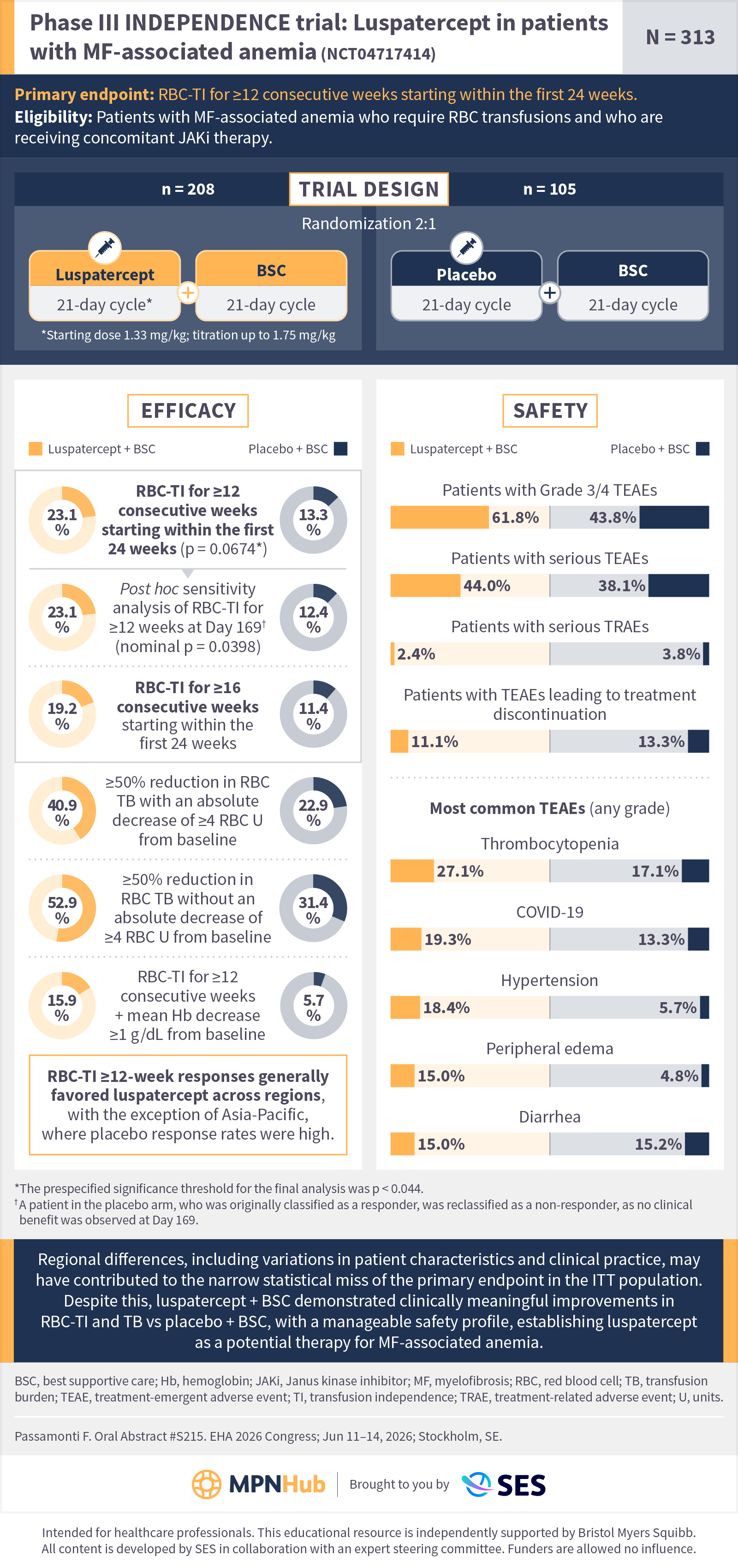
This educational resource is independently supported by Bristol Myers Squibb. All content is developed by SES in collaboration with an expert steering committee. Funders are allowed no influence.
References
Please indicate your level of agreement with the following statements:
The content was clear and easy to understand
The content addressed the learning objectives
The content was relevant to my practice
I will change my clinical practice as a result of this content
This content is accurate as of the date of publication and is not updated retrospectively. Please refer to the latest available evidence, guidelines, and relevant regulatory information when making clinical decisions.
Your opinion matters
Among patients with myelofibrosis and isolated anemia at presentation, with no indication for treatment with a JAK inhibitor, how often do you use anemia-directed treatments (EMAs, ESAs, danazol, etc.) as monotherapy?