All content on this site is intended for healthcare professionals only. By acknowledging this message and accessing the information on this website you are confirming that you are a healthcare professional. If you are a patient or carer, please visit the MPN Advocates Network.
The MPN Hub website uses a third-party service provided by Google that dynamically translates web content. Translations are machine generated, so may not be an exact or complete translation, and the MPN Hub cannot guarantee the accuracy of translated content. The MPN Hub and its employees will not be liable for any direct, indirect, or consequential damages (even if foreseeable) resulting from use of the Google Translate feature. For further support with Google Translate, visit Google Translate Help.


The MPN Hub is an independent medical education platform, sponsored by GSK, Novartis, Sobi and Takeda and supported through independent educational grants from Bristol Myers Squibb, Blueprint Medicines, Incyte and Merck Sharp & Dohme LLC, Rahway, NJ, USA. Funders are allowed no direct influence on our content. The levels of sponsorship listed are reflective of the amount of funding given. View funders.
Now you can support HCPs in making informed decisions for their patients
Your contribution helps us continuously deliver expertly curated content to HCPs worldwide. You will also have the opportunity to make a content suggestion for consideration and receive updates on the impact contributions are making to our content.
Find out more
Create an account to access:
Bookmark & personalize site content
Receive alerts for new content in your areas of interest
View MPN content recommended for you
Symposium | Future perspectives for cytopenic MF: Panel discussion and Q&A
 Jean-Jacques Kiladjian
 Claire Harrison
 Steffen Koschmieder
Do you know... According to guideline recommendations and real-world evidence, which of the following is the most appropriate first-line treatment approach for patients with myelofibrosis and symptomatic anemia with a platelet count >100 × 109/L?
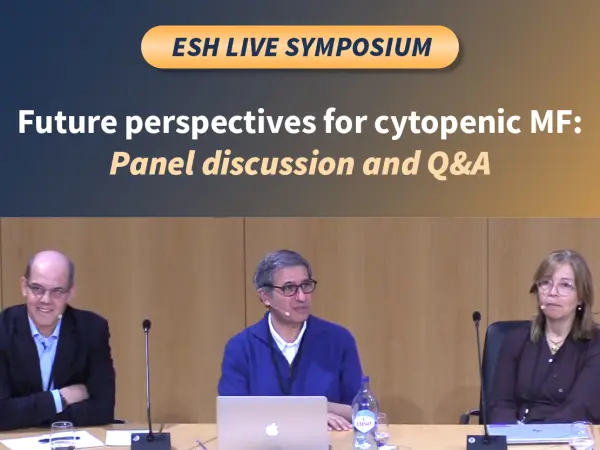
At the European School of Haematology (ESH) 11th Translational Research Conference: Myeloproliferative Neoplasms, Apr 24–26, 2026, Estoril, PT, the MPN Hub held a symposium, titled Patient-centered approaches in myelofibrosis: Tailoring treatment for anemia and thrombocytopenia. During the symposium, MPN Hub Steering Committee Chair Jean-Jacques Kiladjian, Université Paris Cité - Hôpital Saint-Louis, Paris, FR, and Steering Committee members Steffen Koschmieder, Uniklinik RWTH Aachen, DE, and Claire Harrison, Guy’s and St Thomas’ NHS Foundation Trust, London, UK, discuss future perspectives for cytopenic myelofibrosis (MF) during a panel discussion and Q&A session.
Symposium | Future perspectives for cytopenic MF: Panel discussion and Q&A
Symposium | Future perspectives for cytopenic MF: Panel discussion and Q&A
In this session, Kiladjian, Koschmieder, and Harrison discuss practical approaches to the management of cytopenias in MF, including treatment selection, management of treatment-emergent anemia, supportive care strategies, and future directions for individualized and combination therapies.
Key points
- Management of MF-associated anemia should consider the timing of onset, severity, ongoing spleen/symptom response, and available treatment options.1,2
- Early-onset anemia (typically within the first 16 weeks) may be transient; unnecessary ruxolitinib dose reductions should be avoided where possible because efficacy is dose dependent.1
- Red blood cell transfusions may be used as supportive therapy for early treatment-related anemia and may become unnecessary as hemoglobin recovers.1–3
- In patients with sustained spleen and symptom benefit but persistent anemia, addition of an anemia-directed therapy may be considered before switching Janus kinase (JAK) inhibitor therapy.1–3
- Switching to an alternative JAK inhibitor may be appropriate for patients with clinically significant or severe anemia, particularly when anemia limits continued treatment.2,3
- Direct switching between ruxolitinib and momelotinib has been shown to be feasible in clinical practice.4
- First-line treatment selection should be individualized according to disease phenotype, including anemia severity, thrombocytopenia, splenomegaly, symptom burden, comorbidities, and patient preferences.1–3
- Clinically relevant anemia, rather than hemoglobin threshold alone, should guide treatment selection, although hemoglobin <10 g/dL was discussed as a practical consideration.1–3
- In the context of progression from essential thrombocytopenia (ET) to MF, new or worsening cytopenias after a prolonged period of stable treatment should prompt evaluation for disease progression, including assessment of symptoms, lactate dehydrogenase, peripheral blood smear, circulating blasts, and repeat bone marrow examination when appropriate.3
- Limited clinical experience exists with erythropoiesis-stimulating agents added to JAK inhibitor therapy; thrombotic risk should be considered and monitored, particularly in patients with additional risk factors.3
- Evidence supporting sodium-glucose co-transporter-2 (SGLT2) inhibitors for improving anemia in MF remains preliminary.5
- When treating patients with MF and anemia, potential adverse events, for example neuropathy, should be carefully considered. Patient education regarding adverse events, as well as strategies for their prevention and management, should be optimized.6
- Future management of MF is expected to incorporate both single-agent treatment and combination strategies in increasingly personalized treatment approaches based on disease characteristics and patient factors.6
This educational resource is independently supported by GSK. All content is developed by the faculty in collaboration with SES. Funders are allowed no influence.
References
Please indicate your level of agreement with the following statements:
The content was clear and easy to understand
The content addressed the learning objectives
The content was relevant to my practice
I will change my clinical practice as a result of this content
This content is accurate as of the date of publication and is not updated retrospectively. Please refer to the latest available evidence, guidelines, and relevant regulatory information when making clinical decisions.
More from this series:
Symposium series | Patient-centered approaches in myelofibrosis: Tailoring treatment for anemia and thrombocytopenia


Your opinion matters
Among patients with myelofibrosis and isolated anemia at presentation, with no indication for treatment with a JAK inhibitor, how often do you use anemia-directed treatments (EMAs, ESAs, danazol, etc.) as monotherapy?