All content on this site is intended for healthcare professionals only. By acknowledging this message and accessing the information on this website you are confirming that you are a healthcare professional. If you are a patient or carer, please visit the MPN Advocates Network.
The MPN Hub website uses a third-party service provided by Google that dynamically translates web content. Translations are machine generated, so may not be an exact or complete translation, and the MPN Hub cannot guarantee the accuracy of translated content. The MPN Hub and its employees will not be liable for any direct, indirect, or consequential damages (even if foreseeable) resulting from use of the Google Translate feature. For further support with Google Translate, visit Google Translate Help.


The MPN Hub is an independent medical education platform, sponsored by GSK, Novartis, Sobi and Takeda and supported through independent educational grants from Bristol Myers Squibb, Blueprint Medicines, Incyte and Merck Sharp & Dohme LLC, Rahway, NJ, USA. Funders are allowed no direct influence on our content. The levels of sponsorship listed are reflective of the amount of funding given. View funders.
Now you can support HCPs in making informed decisions for their patients
Your contribution helps us continuously deliver expertly curated content to HCPs worldwide. You will also have the opportunity to make a content suggestion for consideration and receive updates on the impact contributions are making to our content.
Find out more
Create an account to access:
Bookmark & personalize site content
Receive alerts for new content in your areas of interest
View MPN content recommended for you
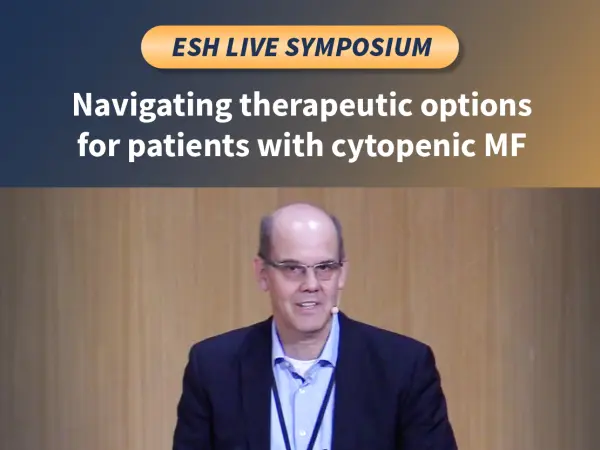
Symposium | Navigating therapeutic options for patients with cytopenic MF
Featured:
 Steffen Koschmieder
Do you know... Which of the following therapies have demonstrated efficacy in patients with myelofibrosis and severe thrombocytopenia (platelets <50 × 109/L)?
At the ESH 11th Translational Research Conference: Myeloproliferative Neoplasms, April 24–26, 2026, Estoril, PT, the MPN Hub held a symposium, titled Patient-centered approaches in myelofibrosis: Tailoring treatment for anemia and thrombocytopenia. During the symposium, MPN Hub Steering Committee member Steffen Koschmieder, Uniklinikum RWTH Aachen, Aachen, DE, delivered a presentation on navigating therapeutic options for patients with cytopenic myelofibrosis (MF).
Symposium | Navigating therapeutic options for patients with cytopenic MF
Symposium | Navigating therapeutic options for patients with cytopenic MF
In this presentation, Koschmieder discusses current therapeutic approaches to cytopenic MF, including a review of key data on outcomes with momelotinib, pacritinib, luspatercept, and pelabresib and selinexor in combination with ruxolitinib.
Key points
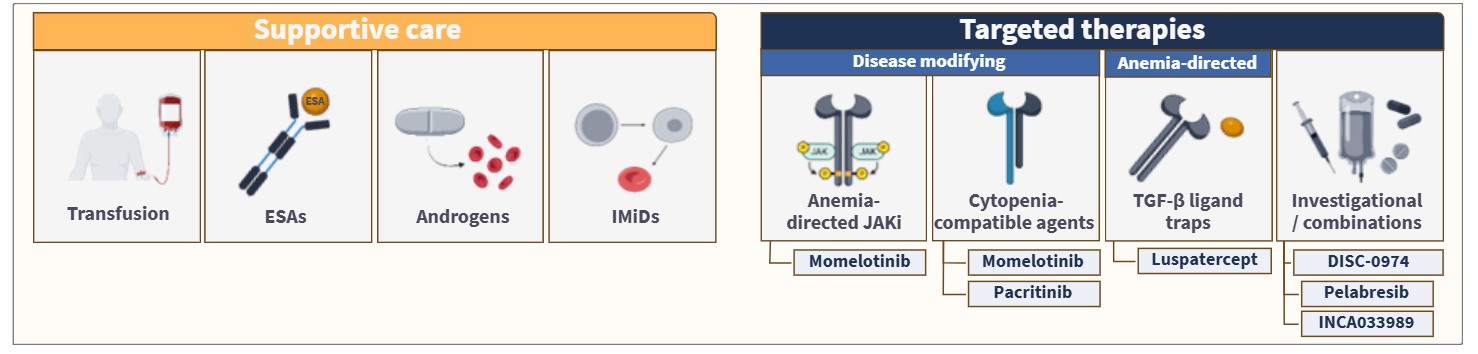
- The management of cytopenic MF requires balancing the treatment of cytopenias with MF-directed therapy. Although cytopenias have traditionally been managed with supportive approaches, targeted therapies for cytopenias and cytopenic MF have recently emerged (Figure 1).1–5
- Two targeted therapies are currently approved for the treatment of patients with cytopenic MF.
- Momelotinib is approved in the US for adult patients with intermediate or high-risk MF, including primary MF, post-polycythemia vera (PV) MF, or post-essential thrombocythemia (ET) MF, with anemia, and in the EU for splenomegaly or other disease-related symptoms in adult patients with moderate to severe anemia who have primary MF, post-PV MF, or post-ET MF and who are Janus kinase inhibitor (JAKi)-naïve or have been treated with ruxolitinib.6,7
- Pacritinib is approved in the US for adult patients with intermediate or high-risk MF, including primary MF, post-PV MF, or post-ET MF, with a platelet count <50 × 109/L.8
Figure 1. Supportive care and targeted therapies for cytopenic myelofibrosis*
- Momelotinib maintained spleen and symptom control while improving transfusion outcomes across the phase III SIMPLIFY-1 (NCT01969838; N = 432), SIMPLIFY-2 (NCT02101268; N = 156), and MOMENTUM (NCT04173494; N = 195) trials.9–11
- Across these trials, momelotinib maintained or improved hemoglobin levels over time, and 77–87% of patients maintained or improved transfusion intensity vs baseline.9-12
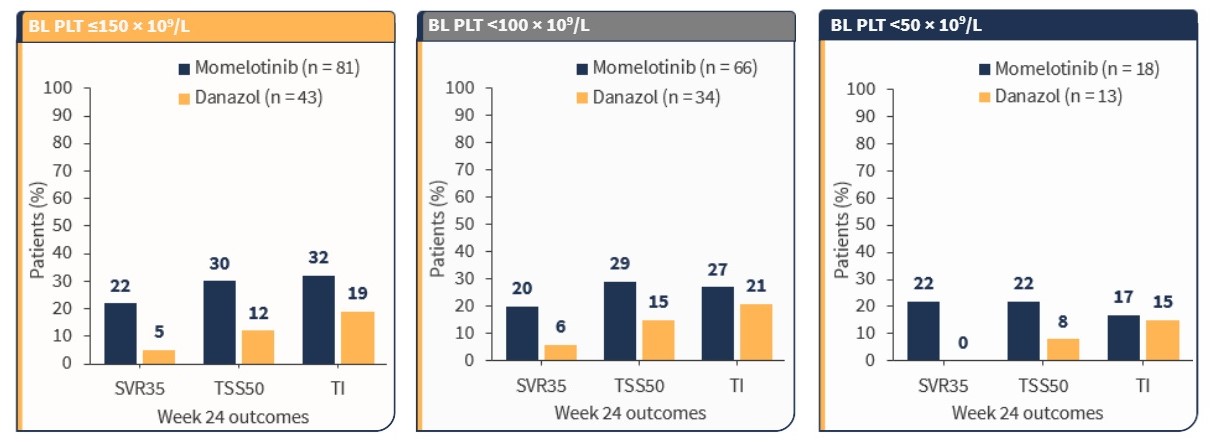
- In a post hoc analysis of the MOMENTUM trial, efficacy was observed across platelet subgroups, including <50 × 10⁹/L (Figure 2), suggesting that the activity of momelotinib may extend beyond anemia to include patients with thrombocytopenia.13
Figure 2. MOMENTUM sub-analysis: Outcomes in myelofibrosis with thrombocytopenia*
- Pacritinib improved clinical outcomes in patients with MF and thrombocytopenia in the phase III PERSIST-2 trial (NCT02055781), with additional evidence of anemia benefit demonstrated by a sub-analysis of transfusion independence rates.14–16
- Findings from the phase II ACE-536-MF-001 (NCT03194542) and phase II ODYSSEY (NCT06517875) trials demonstrated that luspatercept improved anemia outcomes in patients with MF, with or without JAK inhibitor therapy.17-19
- In the phase III MANIFEST-2 trial (NCT04603495), the addition of pelabresib to ruxolitinib was associated with increased thrombocytopenia and reduced anemia compared with ruxolitinib monotherapy.21,21
- Initial topline results from the phase III SENTRY trial (NCT04562389) demonstrated that selinexor in combination with ruxolitinib improved spleen responses (47% vs 23% at Week 36), with similar symptom improvement vs ruxolitinib monotherapy but with frequent cytopenias (thrombocytopenia, 59% vs 43%; anemia, 57% vs 58%).22
- Emerging therapies may directly improve cytopenias or allow reduced JAK inhibitor dosing without sacrificing efficacy in MF.2–5
This educational resource is independently supported by GSK. All content is developed by the faculty in collaboration with SES. Funders are allowed no influence.
References
Please indicate your level of agreement with the following statements:
The content was clear and easy to understand
The content addressed the learning objectives
The content was relevant to my practice
I will change my clinical practice as a result of this content
More from this series: